The AKC's Australian Cattle Dog page sums the breed up as "Loyal / Intelligent / Tenacious." Its Dutch Shepherd page says "intelligent / lively / athletic." Here is how the two compare, from both AKC breed pages, both official standards and an AKC expert article. Both are high-energy herding dogs that want a job: the AKC scores each 5 of 5 for energy. Our honest read is that neither is the easy choice for a quiet home. We breed Dutch Shepherds, and we think the Cattle Dog may be the easier fit for a home that wants a smaller dog, though the AKC adds a caution about children, below.
At a glance
Heights come from each official standard. Weights come from the AKC breed pages, which give one range for each breed. Trait scores are each AKC breed page's own score out of 5, with the two end labels of each scale as the AKC shows them.
- AKC status: the AKC says the Australian Cattle Dog "was admitted to the AKC in 1980 and became a charter member of the AKC Herding Group upon the founding of the group in 1983." The Dutch Shepherd is in the Foundation Stock Service, has been assigned the Herding Group designation, and moves into the AKC Stud Book on June 30, 2027.
- Height: Cattle Dog, approximately 18 to 20 inches for males and 17 to 19 inches for females. Dutch Shepherd, 22½ to 24½ inches for males and 21½ to 23½ inches for females.
- Weight: Cattle Dog, 35 to 50 pounds. Dutch Shepherd, 42 to 75 pounds.
- Energy: 5 of 5 for both, from "Couch Potato" to "High Energy."
- Mental stimulation needs: Cattle Dog 4 of 5, Dutch Shepherd 5 of 5, from "Happy to Lounge" to "Needs a Job or Activity."
- Trainability: Cattle Dog 4 of 5, Dutch Shepherd 5 of 5, from "Self-Willed" to "Eager to Please."
- Affection with family: Cattle Dog 3 of 5, Dutch Shepherd 5 of 5, from "Independent" to "Lovey-Dovey."
- Openness to strangers: 3 of 5 for both, from "Reserved" to "Everyone Is My Best Friend."
- Good with young children: 3 of 5 for both, from "Not Recommended" to "Good With Children."
- Grooming frequency: Cattle Dog 1 of 5, Dutch Shepherd 2 of 5, from "Monthly" to "Daily."
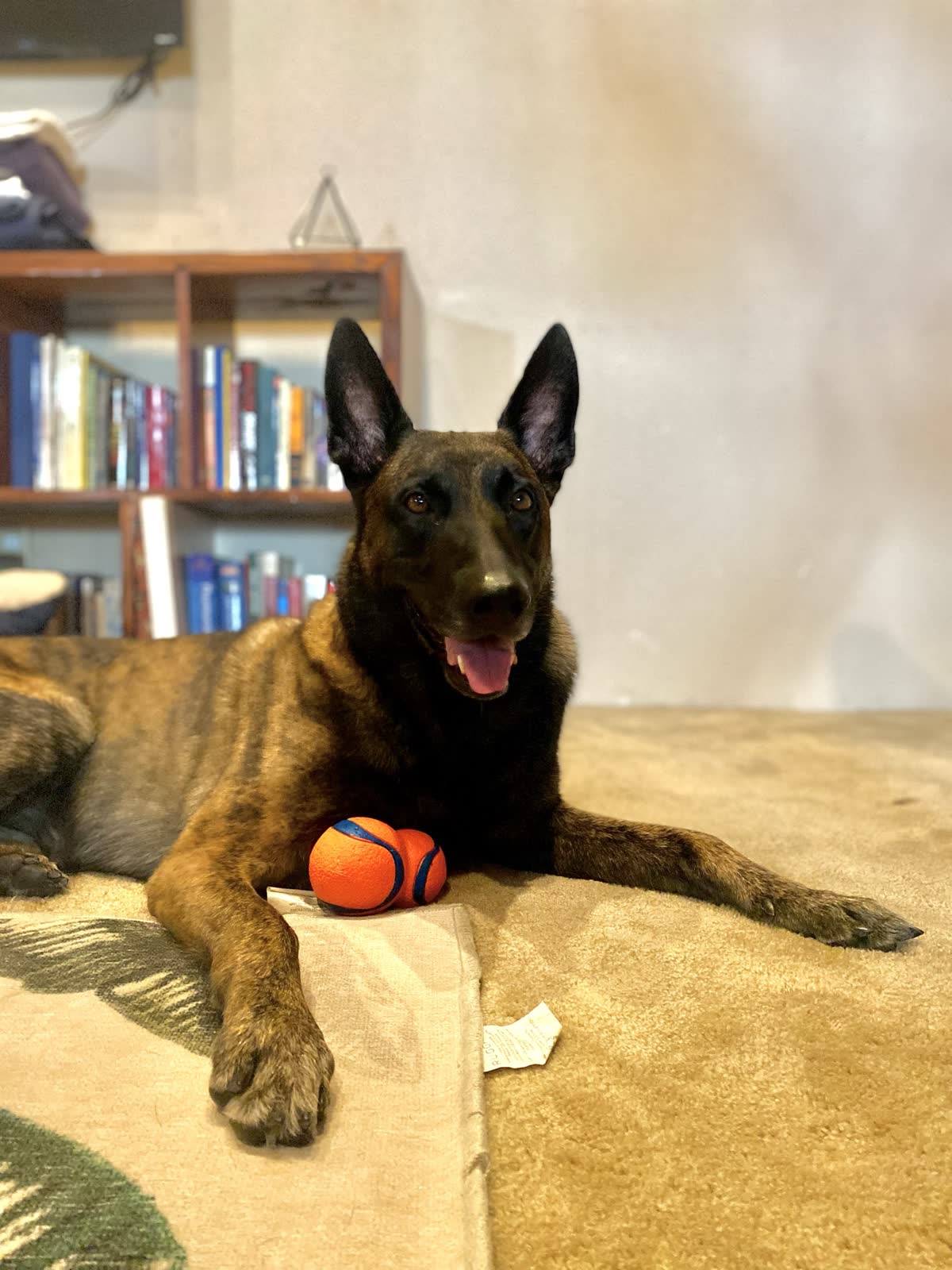
Our pair, for the record: Azul (our female) is 75 to 80 pounds and Dabo (our male) is heavier. Those are two adult dogs, not a promise about any puppy's adult size. Our size guide has more, and our Stud Book explainer covers the 2027 move.
What each was built for
The AKC says the Australian Cattle Dog "made vital contributions to the growth of the continent's beef industry," and the breed standard names its prime function: "the control and movement of cattle in both wide open and confined areas."
The AKC says the Dutch Shepherd "was developed as an all-purpose farm dog, working originally as a farm guard, drover, and livestock dog." One description centers on cattle, the other on a whole farm's work.
Size and coat
On the AKC's numbers the Cattle Dog is lower on both height and weight, and the AKC calls it "compact but muscular." The AKC says it has "a smooth, double-layer coat" and "generally needs just a quick brushing once a week and an occasional bath," but "sheds his undercoat twice a year," when "every few days he will need a thorough brushing-out." For the Dutch Shepherd, the AKC says the short-hair types "will only need occasional brushing," with daily brushing in the spring and fall shedding periods, while the long-haired dogs "will need to be groomed about once per week." Both score 3 of 5 for shedding. Our coat guide covers the Dutch coat types.
Energy and daily work
"A very active, high-energy dog, the Australian Cattle Dog needs more than just a quick walk and playtime in the yard," the AKC says. On a working farm, it adds, "this may not be an issue, especially if there are animals to herd," and in other living situations, "going with his owner on runs every day, or nearly every day, is a good outlet for his energy."
For the Dutch Shepherd the AKC says: "Driven to do its chosen work, this dog will differentiate between work, play, and chill time, adjusting its energy level accordingly." Our guides to exercise and mental exercise cover that side.
Training and mental work
The AKC says the Cattle Dog "is only really happy when on the job," that "early socialization and obedience training are a must," and that these herders are "intelligent enough to routinely outsmart their owners."
For the Dutch Shepherd the AKC warns: "Without training, this breed will become very independent and will start to make its own decisions, so obedience training is highly recommended." Our guide to teaching a Dutch Shepherd to come when called covers the Dutch side.
People and strangers
The AKC scores both breeds 3 of 5 for openness to strangers. Its Cattle Dog page says the breed is "true-blue loyal, famously smart, tenacious, ever alert, and may be wary of strangers." The Dutch Shepherd standard asks for "loyalty and reliability, alertness, and watchfulness." Our temperament guide goes deeper.
With young children, both score 3 of 5, and both breed pages carry the same rule: "Dogs should always be supervised around young children, or children of any age who have little exposure to dogs." The expert article says "ACDs can be a good choice for the right family," but that their "herding instincts may lead them to nip at or try and corral kids, making them best suited for families with older children." The Dutch Shepherd is a herding breed too, and our puppy biting guide covers herding nips.
When the Cattle Dog may be the easier fit
- You want a smaller dog. The AKC's weight range is 35 to 50 pounds, against 42 to 75 for the Dutch Shepherd.
The expert article adds a condition: "Active, experienced owners are often the best fit for this loyal and hardworking breed."
When the Dutch Shepherd may fit
- Your family is active and familiar with dogs, and can give "proper mental and physical exercise" and obedience training, which the AKC highly recommends.
- You want a dog the AKC scores 5 of 5 for affection with family and for trainability, against 3 of 5 and 4 of 5 for the Cattle Dog.
The honest answer
Both are high-energy herding dogs that want a job, and the AKC scores them the same, 3 of 5, for young children and openness to strangers. If you want a smaller dog, the Cattle Dog may be the easier fit, though the expert article says its herding instincts may lead it to nip at or try and corral kids, making it best suited for families with older children. If your family is active, familiar with dogs and wants a partner the AKC scores higher for affection with family and trainability, the Dutch Shepherd may be a good fit. We would rather say so than point you toward the wrong dog.
Still weighing breeds? See our comparisons with the Australian Shepherd and the Border Collie, or ask whether a Dutch Shepherd can fit a quieter home, then work through our ten honest questions. Our day-in-the-life guide shows what the work looks like.
Sources
- American Kennel Club: Australian Cattle Dog breed page (height, weight, trait scores, history, grooming, exercise, training, temperament)
- American Kennel Club: Official Standard of the Australian Cattle Dog (PDF; approved January 11, 1999, effective February 24, 1999; function, height, coat, temperament)
- American Kennel Club: Is the Australian Cattle Dog a Good Fit for You? (Micaela Erickson, updated August 18, 2026; families, children, strangers, owners)
- American Kennel Club: Dutch Shepherd breed page (weight, AKC status, trait scores, origin, grooming, exercise, training)
- American Kennel Club: Official Standard for the Dutch Shepherd (PDF; height, coat, color, temperament)
- American Kennel Club: Board of Directors meeting minutes, September 15 to 16, 2026 (PDF; Dutch Shepherd Stud Book entry June 30, 2027)