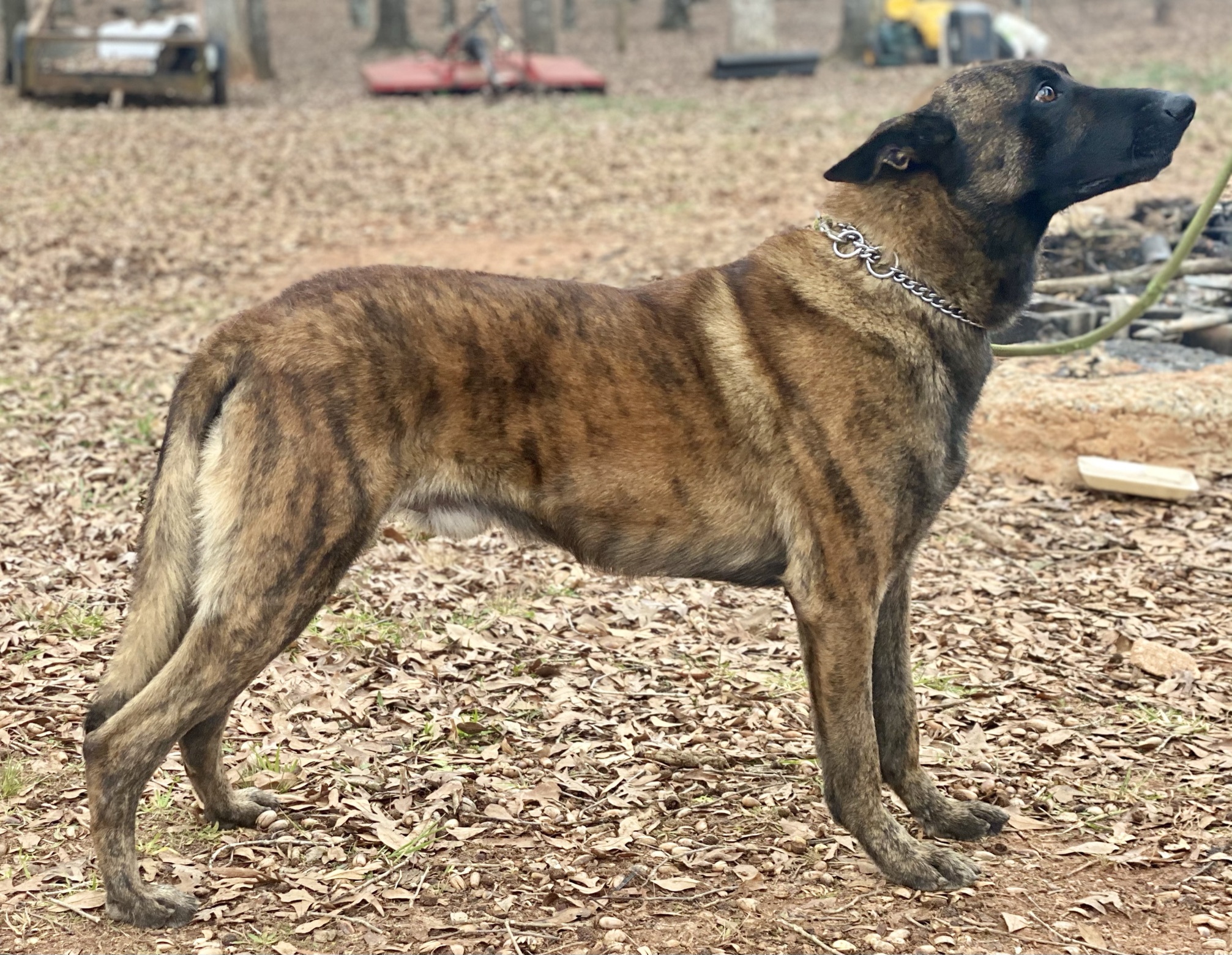
A brindle dog with a shepherd's shape and upright ears might be a Dutch Shepherd. It might also be a mix, or another breed entirely. Looks can point you toward the breed, but they can't settle the question, and by the AKC's own account, neither can its DNA profile. Here is what the breed standards tell you to look for, which other breeds wear brindle, what a Dutch Shepherd and Malinois cross is on paper, and what actually answers "is my dog a Dutch Shepherd?"
What the standards tell you to look for
Start with color. The AKC's standard reads: "Brindle. The base color is golden or silver." It adds that the brindle "is clearly present all over the body and in the ruff, breeches and tail." The UKC, which recognized the breed on January 1, 1995, is just as firm: "The brindle color pattern is the only acceptable pattern in the Dutch Shepherd."
One catch: the rough coat. The AKC standard says of rough-haired dogs, "The brindle color may be less pronounced because of the tousled coat." So on a rough-coated dog, look closely.
Then shape and size. The AKC's breed page gives average sizes of 21.5 to 24.5 inches and 42 to 75 pounds. The standard asks for a dog a little longer than tall, at "a 10 to 9 ratio," with ears that are "medium sized, stiff, and erect." It lists "Drooping or hanging ears" as a disqualification. Our head-to-tail guide walks through the rest of the standard.
Brindle is not a Dutch Shepherd trademark
The AKC defines brindle on its Plott Hound page as "a streaked or striped pattern of dark hair imposed on a lighter background." Other breeds wear it too. Two that come close to a Dutch Shepherd in size:
- Plott Hound: the AKC says the Plott stands "as high as 25 inches at the shoulder" and "The flashy coat comes in an array of brindle-stripe patterns, from black flecked with gold to flaming orange and russet, in addition to some solid colors." The tell is the ears: "The medium-length ears hang gracefully," the trait the AKC's Dutch Shepherd standard disqualifies.
- Boxer: "A male can stand as high as 25 inches at the shoulder; females run smaller." The AKC adds: "The coat can be fawn or brindle, with white markings."
The two shepherds we compare the Dutch with most often on this site go the other way. Brindle is not among the colors on the AKC's breed pages for the Belgian Malinois or the German Shepherd Dog, and the Malinois standard says "The blackening must not appear as patched or brindled." So brindle on a shepherd-shaped dog is a real clue. It is still only a clue. Our brindle coat guide covers the color itself.
What about a Dutch Shepherd and Malinois cross?
A dog with one Dutch Shepherd parent and one Belgian Malinois parent is a mix, however much it looks like either breed. Telling them apart by eye is hard to begin with: the UKC's standard says the Dutch Shepherd is "very similar in coat types and physical characteristics, except for color, to the Belgian Shepherd Dog."
A mix still has a place at the AKC. Its Canine Partners program says "All dogs are welcome to enroll including mixed breed dogs and any dogs without eligibility for full AKC registration." Enrolled dogs can earn titles in events including agility, obedience, rally, tracking, Fast CAT, scent work and Farm Dog Certified. The AKC's condition: "All dogs enrolled must be spayed or neutered." An intact puppy can enroll, but must be spayed or neutered before it competes in an AKC event.
Whatever your dog's papers say, if it has a working dog's energy, our guides to exercise and brain work are a good place to start.
What actually answers the question
For a purebred, the answer is on paper: a registration and a pedigree for both parents. The Dutch Shepherd is in the AKC's Foundation Stock Service and moves into the AKC Stud Book on June 30, 2027. It has been in the UKC since 1995.
DNA has a narrower job here. The AKC says plainly: "AKC DNA Profiles cannot determine the breed of a dog or if a dog is purebred." What its DNA program does is check parentage: "Comparison of the DNA profiles of a dam, sire, and pup(s) will determine, with greater than 99% confidence, whether the pups are from the tested dam and sire." In other words, the AKC's test can confirm a puppy came from the tested parents. It is the parents' registrations that say what breed they are.
If you're buying a puppy sold as a Dutch Shepherd, ask which registry the parents are in, and ask to see both parents' papers.
New to the breed? Start with our ten honest questions.
Sources
- American Kennel Club: Dutch Shepherd breed page (coat colors, average sizes)
- American Kennel Club: Official Standard for the Dutch Shepherd (PDF; effective January 1, 2017; proportion, ears, coat, color, disqualifications)
- United Kennel Club: Dutch Shepherd breed standard (history, color)
- American Kennel Club: Plott Hound breed page (brindle definition, size, coat, ears)
- American Kennel Club: Boxer breed page (size, coat)
- American Kennel Club: Belgian Malinois breed page and Official Standard of the Belgian Malinois (PDF; colors)
- American Kennel Club: German Shepherd Dog breed page (colors)
- American Kennel Club: Canine Partners (eligibility, spay/neuter rule, events)
- American Kennel Club: DNA Program (what an AKC DNA profile can and can't tell you)