Every puppy uses its mouth. The AKC says play biting is "completely normal for puppy teething and necessary for development," and something you can train away with a few simple steps. A Dutch Shepherd puppy brings two extras to the job: a herding background and a lot of energy. Here is what the AKC and the ASPCA say about teaching a soft mouth, and what a herding breed adds to it.

Why puppies bite
The AKC's Dr. Jerry Klein and certified trainer Kate Naito list five common reasons puppies nip: to share how they feel, to start a game, to explore, genetics, and teething. Dr. Klein calls nipping "usually a 'conversation starter' in puppies," a way to start play.
It is also a long phase. Naito puts it this way: "Since dogs are teething until roughly seven months old, and some dogs have puppy-like play energy well into their second year, it can be a long road."
The herding factor
The AKC has assigned the Dutch Shepherd to its Herding Group. The breed page says that in the past, these dogs were often charged with taking the sheep out to pasture every morning and bringing them back to the barn each evening on their own.
Dr. Klein says breeds in the herding group may nip more often, because they were bred to herd calves and sheep by using their mouths to nip at heels. He names Corgis, Collies and German Shepherds as examples. Naito adds a fair caution: don't make assumptions purely on a dog's breed.
The AKC's guide to herding behavior explains how it shows up at home. The instinct is triggered by movement, and "to a herding dog, however, 'other animals' means the humans in the house, too." It warns that if your kids run away when the dog nips their feet, "that will only trigger the behavior to continue." Its fixes:
- Teach "Watch Me" and "Leave It" so you can redirect your dog's attention when things are moving nearby
- Ask for a sit or a down before you throw the ball or offer the tug toy
- Give the mind and body a real workout, because a smart herding dog will find its own fun if you don't give it something to do
Size matters too. Naito notes that "the bigger the dog, the more painful" play biting can be, and that "families with large, strong, active breeds should be prepared to do lots of age-appropriate training and exercise for their young dogs."
Step one: teach bite inhibition
The ASPCA defines bite inhibition as a dog's ability to control the force of its mouthing. Why it matters, in the AKC's words: "There may come a time when they're in pain or fearful, and they put their mouth on you or someone else." If a dog has learned bite inhibition, the AKC says, it understands that it shouldn't bite down hard.
Puppies usually learn this from each other. When one bites a littermate too hard, the other yelps and play usually stops for a moment. The ASPCA's method copies that:
- Let your puppy mouth your hands in play. When it bites especially hard, give a high-pitched yelp and let your hand go limp
- Praise your puppy for stopping or for licking you, then go back to playing
- Repeat no more than three times in 15 minutes. If yelping does not work, use a short time-out: ignore your puppy for 10 to 20 seconds, or get up and move away
- Work down the list: stop the hardest bites first, then the next-hardest, until your puppy plays with your hands with little or no pressure
One caution from the AKC: for some puppies, the yelp "actually gets them even more worked up and likely to bite." If that is yours, turn quietly around, walk away, or gently put your puppy in its crate for a few minutes to calm down.
Step two: teeth off skin
Once the hard bites are gone, the ASPCA's next goal is no teeth on people at all. Now a time-out comes every time you feel teeth touch your skin: walk away and ignore your puppy for 30 to 60 seconds. Then give the mouth somewhere better to go:
- Keep a chew toy at hand and swap it in for your fingers (AKC)
- Play tug, not wrestle. Naito's rules: your puppy sits before the game starts, and the game lasts only as long as the toy is the only thing being chewed. "The longer the toy, the less likely your dog is to accidentally bite your hand at the other end of it."
- Ankle ambush? Freeze, pull a tug toy from your pocket and wave it. Start moving again once your puppy grabs the toy (ASPCA)
- Mouthy when petted? Feed small treats from your other hand while you pet (ASPCA)
- Rotate the toys. Dr. Klein suggests a few out at a time, swapped each week
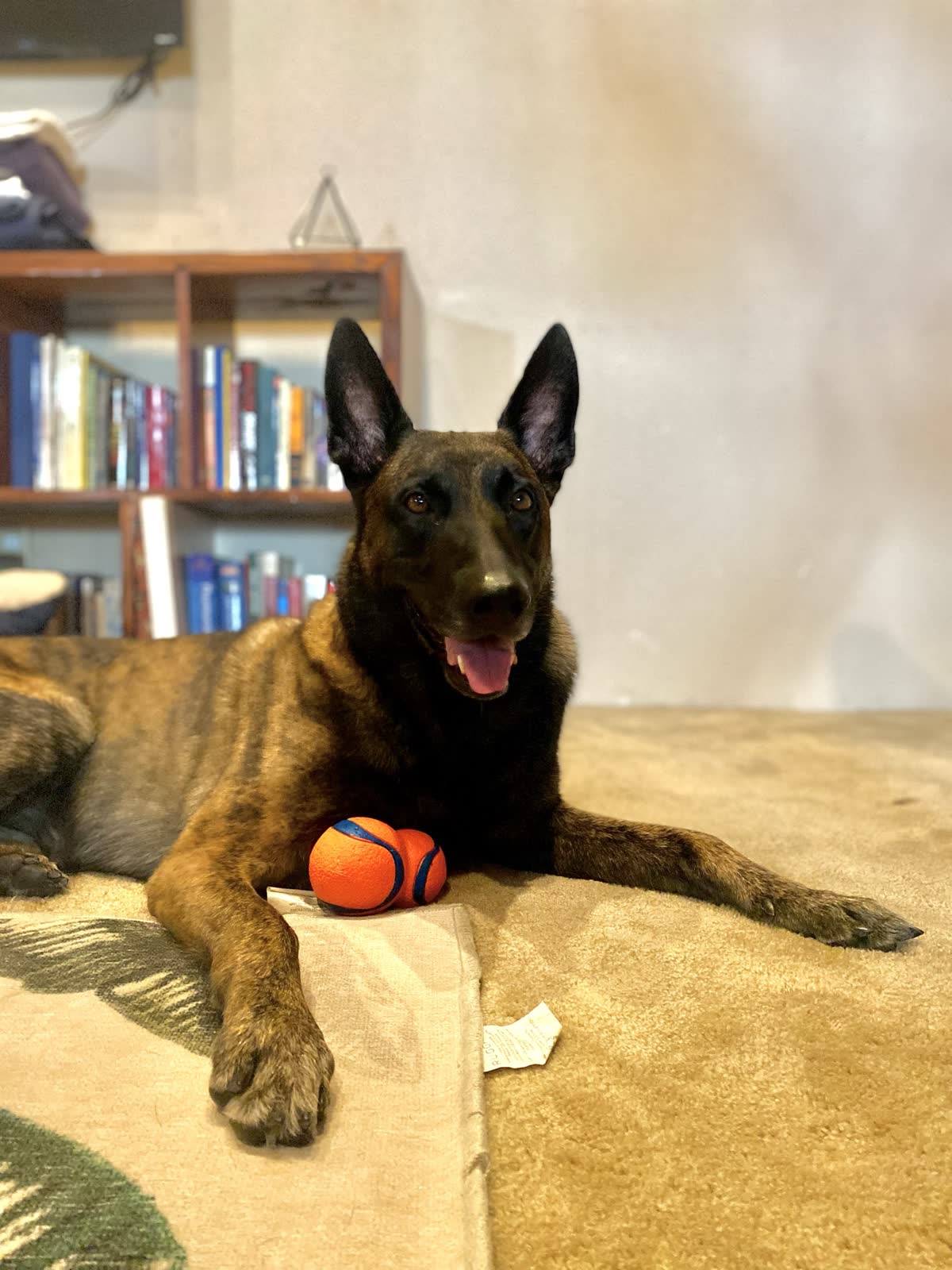
Sometimes a biting puppy is a tired puppy
"Sometimes a biting puppy is really an overtired puppy," the AKC says, and it needs a quiet space or its crate for a nap. Other times it needs a potty break, food or water, or a chance to burn off energy. Keep the crate calm, so your puppy never connects it with punishment. We wrote more about building that rest in The Off-Switch, and about the right amount of exercise for a growing puppy in our exercise guide.
What not to do
- Don't yell. The AKC says it teaches your puppy that biting gets a response, and it can make your puppy fearful of being handled
- Don't hold the muzzle shut as a correction. The AKC's experts say it teaches fear
- Don't hit, slap, scruff-shake or whack the nose. The ASPCA says physical punishment can make puppies bite harder, make them afraid of you, and "can even cause real aggression"
- Don't jerk your hands or feet away. That invites a lunge. Let them go limp instead (ASPCA)
- Don't wave fingers in your puppy's face or roughhouse in ways that wind it up (ASPCA, AKC)
- Don't stop playing. The ASPCA says play builds a strong bond. Teach gentle play, not no play
When to call a pro
Dr. Klein is reassuring: "Play biting does not mean your puppy is vicious." But he adds, "if you haven't been able to moderate the behavior by the time they're 6 months old, it's a good idea to consult an experienced dog trainer or animal behavior specialist."
The ASPCA also describes a puppy "temper tantrum," which is more serious than play. Signs include a stiff or frozen body, lips pulled back to show teeth, growling, and bites that hurt much more than normal mouthing. Don't yelp in that moment. Stay calm, and plan to get a qualified professional involved, because "repeated bouts of biting in frustration are not something that the puppy will simply grow out of."
Planning the first year? Read our guide to the socialization window and working dogs and kids.
Sources
- American Kennel Club: Dutch Shepherd breed page (Herding Group designation, taking sheep to pasture)
- American Kennel Club: How to Stop Puppy Biting and Train Bite Inhibition (normal and necessary, why bite inhibition matters, when the yelp backfires, yelling, chew toys, calm crate time-outs, overtired puppies, Dr. Klein on 6 months)
- American Kennel Club: Why Does My Puppy Nip at Me and Chew on My Clothes? (five reasons, herding-group breeds, size, teething to about seven months, tug rules, toy rotation, muzzle holding)
- American Kennel Club: Why Does My Dog Herd My Kids? (movement as the trigger, kids running away, Watch Me and Leave It, calm behavior before games, exercise)
- ASPCA: Mouthing, Nipping and Biting in Puppies (bite inhibition defined, yelp and time-out method, teeth off skin, ankle ambushes, petting, precautions, temper tantrums)